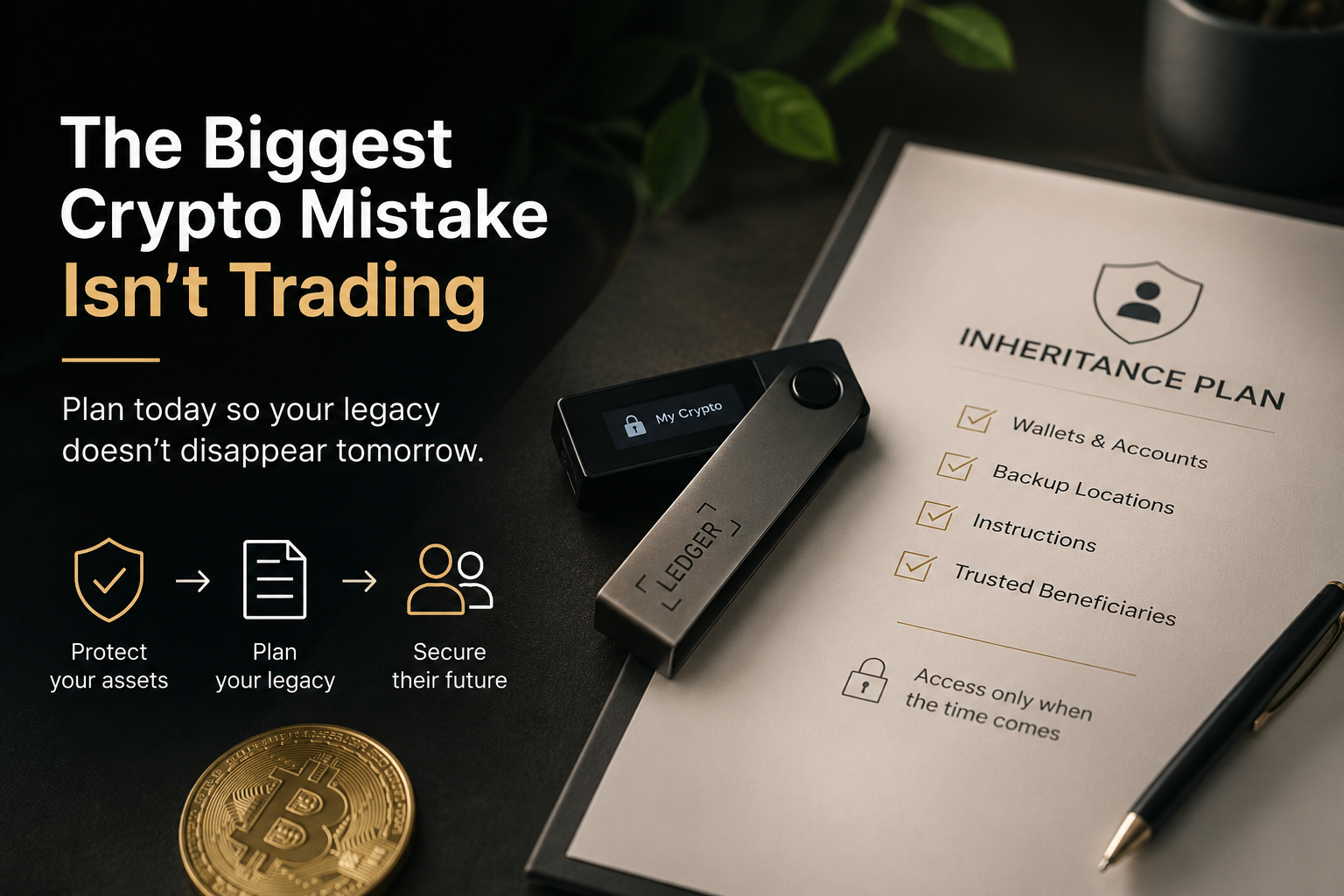
The Biggest Crypto Mistake Isn't Trading
When people talk about mistakes in crypto, they usually think about buying the wrong coin, selling too early, or falling victim to scams.
Those are certainly expensive mistakes.
But there is another one that is often overlooked—and it has nothing to do with investing.
It's not having a plan for what happens to your crypto if you're no longer here.
Crypto doesn't work like a bank
Traditional financial institutions have processes for inheritance.
Banks can identify beneficiaries, courts can validate wills, and assets can eventually be transferred.
Crypto is different.
If your family doesn't know where your wallets are, how they're protected, or how to recover them, your assets may become inaccessible forever.
There is no customer support that can recover a lost seed phrase.
Security isn't the whole picture
Most crypto holders spend a lot of time improving their security:
- Hardware wallets
- Offline backups
- Multi-signature wallets
- Password managers
- Air-gapped devices
These are all excellent practices.
But they only answer one question:
How do I protect my assets while I'm alive?
Very few people stop to ask the next one:
How will my family recover them if I'm gone?
The hidden risk
Imagine someone who has accumulated Bitcoin and other cryptocurrencies for years.
Everything is properly secured.
The seed phrases are hidden.
The hardware wallets are stored safely.
Then something unexpected happens.
Their family knows crypto exists, but they don't know:
- Which wallets contain funds.
- Which exchanges were used.
- Where backups are stored.
- Which instructions should be followed.
The crypto wasn't stolen.
It simply became inaccessible.
Planning isn't about expecting the worst
Creating an inheritance plan doesn't mean expecting something bad to happen.
It's no different from buying insurance or writing a traditional will.
It's simply preparing for situations that nobody wants but that everyone should consider.
A good crypto inheritance plan should help trusted beneficiaries understand what assets exist and how they can safely recover them—without unnecessarily exposing sensitive information today.
Final thoughts
The biggest risk in crypto isn't always market volatility.
Sometimes it's failing to prepare for the only event that every investor will eventually face.
Building wealth is important.
Making sure it doesn't disappear with you is just as important.