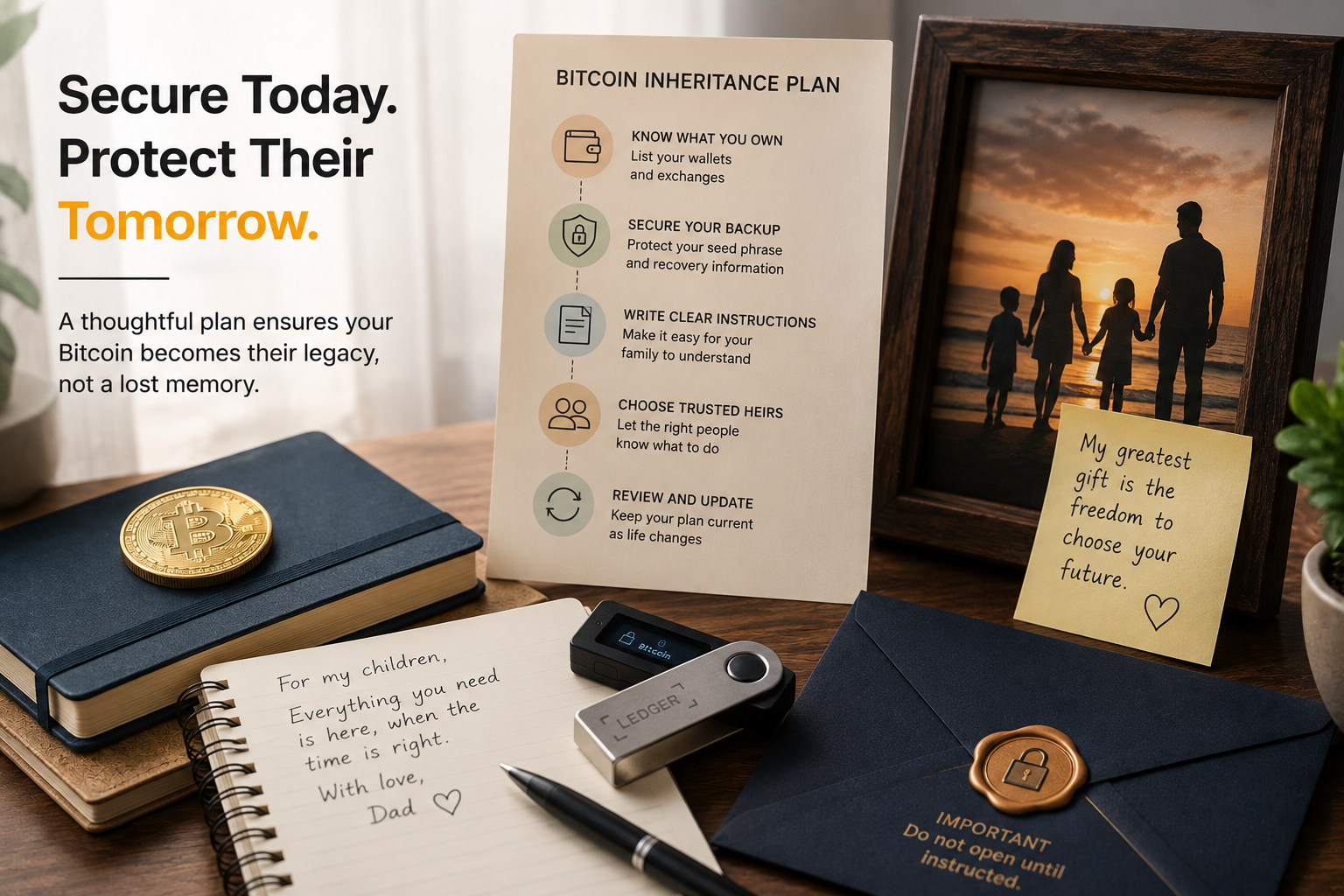
How to Leave Bitcoin to Your Children: A Step-by-Step Guide
Bitcoin gives you something traditional financial assets cannot: direct control over your money.
But that control creates an important responsibility.
If you want your children to inherit your Bitcoin one day, simply owning the cryptocurrency is not enough. You need to make sure they can actually find, understand, and recover it when the time comes.
Here is a practical way to think about Bitcoin inheritance.
1. Make a List of Your Bitcoin Holdings
The first step is knowing exactly what needs to be inherited.
You may have Bitcoin stored in a hardware wallet, another self-custody wallet, or on one or more cryptocurrency exchanges.
Create an inventory of the platforms and wallets you use.
You do not necessarily need to write down your private keys in this inventory. The goal is to make sure your heirs know that these assets exist and where the recovery process begins.
2. Secure Your Seed Phrase
For self-custody Bitcoin, the seed phrase is usually the most important piece of information required to recover the wallet.
Never store it in an unsecured digital document, email, cloud drive, or messaging application.
Consider a durable physical backup and protect it against unauthorized access.
Remember that anyone who obtains the seed phrase may be able to control the funds.
3. Separate Access From Instructions
Your children may eventually need two different things:
- The information required to recover the assets.
- Instructions explaining what to do with that information.
Keeping these things completely separate can improve security.
For example, your recovery information can remain securely protected while your heirs have access to instructions explaining which wallet exists, what type of device is involved, and what steps they should take.
4. Explain the Basics
Do not assume your children understand cryptocurrency.
Knowing that you own Bitcoin does not mean they know how to use a hardware wallet, restore a wallet, or recognize a legitimate recovery process.
Your instructions should be simple enough for someone who has never owned cryptocurrency before.
5. Consider What Happens if You Become Incapacitated
Inheritance planning usually focuses on death, but that is not the only situation that matters.
An accident, illness, or other unexpected event could leave you unable to manage your assets.
A good plan should consider both temporary and permanent loss of access.
6. Keep Your Plan Updated
Your crypto portfolio may change over time.
You might buy a new hardware wallet, move funds to another address, start using an exchange, or change your recovery setup.
An inheritance plan that was accurate five years ago may no longer be useful today.
Review your information periodically and update it whenever something important changes.
7. Tell Your Family What They Need to Know
There is a difficult balance between security and accessibility.
If nobody knows that your Bitcoin exists, your family may never look for it.
But giving someone your complete recovery information unnecessarily can create a serious security risk.
The solution is not necessarily to reveal everything immediately. Instead, create a clear process that allows the right person to access the necessary information at the appropriate time.
8. Test Your Plan
One of the best ways to find problems is to test your recovery process before you actually need it.
Ask yourself:
Could someone you trust follow the instructions?
Would they know which wallet to use?
Would they know where to begin?
Could they identify outdated information?
A plan that works only in your head is not a reliable inheritance plan.
Bitcoin Inheritance Is About More Than a Seed Phrase
A seed phrase is extremely important, but it is only one part of the problem.
Your family may also need to know that the Bitcoin exists, which wallet contains it, how to recover it, what information is current, and what they should do after gaining access.
The goal is to create a process that is both secure and understandable.
Final Thoughts
Bitcoin allows you to become your own bank, but that also means you are responsible for planning what happens when you can no longer manage your assets.
If you want your children to inherit your Bitcoin, start by documenting what exists, securing your recovery information, creating clear instructions, and reviewing the plan regularly.
The best time to create an inheritance plan is before your family needs it.